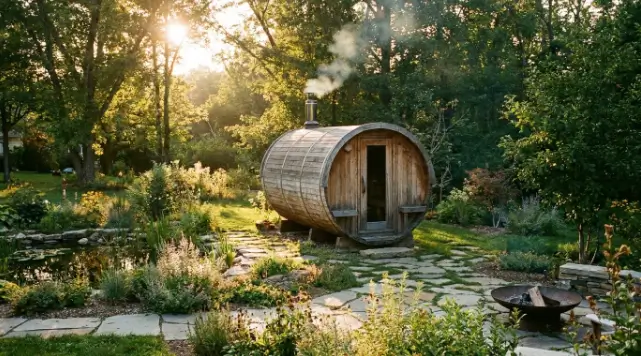
Most full-size barrel saunas need 240V because their heaters run 6 to 9 kilowatts, and a standard 120V household circuit cannot safely deliver that much power to a single fixed appliance. A handful of small, low-wattage heaters under roughly 3 kilowatts can run on a dedicated 120V, 20-amp circuit, but that setup trades away faster heat-up and higher ceiling temperature. Knowing which category your heater falls into before you buy saves a surprise electrical bill later.
120V Versus 240V: What Is Actually Different?
A 120V circuit is what most household outlets already run on, and a heater built for it is limited to roughly 1.5 to 3 kilowatts to stay within safe amperage on a standard circuit. A 240V circuit carries twice the voltage on a dedicated line, which lets a heater draw more total wattage without needing an unreasonably thick gauge of wire. For a barrel sauna specifically, that difference translates directly into recovery speed: a 240V heater sized correctly for the interior volume can reach operating temperature in 30 to 45 minutes, while a 120V unit in the same space often needs an hour or more and may struggle to hold the top of its range on a cold night.
120V Barrel Saunas: Where They Make Sense
A 120V plug-in heater is worth considering for a smaller barrel used mostly by one or two people who want to avoid running new wire entirely. Some models are built to plug into an existing outdoor-rated outlet, which removes the electrician visit from the project altogether. The tradeoff is real: lower maximum temperature, slower heat-up, and less margin for recovering quickly between rounds if more than one person uses it back to back. For someone testing whether a barrel sauna fits their routine before committing to a full electrical upgrade, this is a reasonable starting point.
240V Barrel Saunas: Where They Make Sense
A 240V heater is the standard choice for anyone buying a full-size barrel meant for regular use by more than one person. Heaters in the 6 to 9 kilowatt range hold a steady temperature through back-to-back rounds and recover in a few minutes once the door closes, which matters if a household of three or four is taking turns. The cost is the electrical work itself. Running a dedicated 240V circuit from the main panel to a backyard barrel, especially if the run is trenched underground for a buried cable, is frequently the single largest expense in the entire project, sometimes rivaling the price of the sauna itself depending on distance and local labor rates.
What Does the Electrical Work Actually Involve?
A licensed electrician typically needs to run a dedicated circuit from the panel, which means a new breaker sized for the heater’s amperage, wire rated for outdoor and possibly underground use, and a weatherproof disconnect near the barrel itself. Most jurisdictions require a permit and inspection for a fixed 240V outdoor circuit, and skipping that step can create real problems later with homeowner’s insurance or during a home sale. Some of the wiring and trenching work is within reach for an experienced DIYer, but the final panel connection and inspection sign-off generally need a licensed professional, particularly for anything exposed to weather and ground moisture.
How to Budget for the Wiring Before You Buy
Get a rough electrical quote before finalizing which barrel to buy, not after. Distance from the panel is the biggest cost driver, so a barrel placed close to the house is meaningfully cheaper to wire than one at the back of a large yard. Ask any barrel sauna seller for the exact heater wattage and voltage requirement before ordering, since that number determines the wire gauge and breaker size an electrician will quote. Sellers who list heater specs clearly next to the price, including SweatDecks, make this comparison easier than ones that only advertise “person capacity” without the electrical detail underneath it.
Is the 240V Upgrade Worth It Long Term?
For anyone planning to use a barrel sauna regularly rather than occasionally, yes. The faster recovery time and steadier top-end temperature make the difference between a unit that gets used weekly and one that becomes a chore because it never quite gets hot enough before everyone needs to be somewhere else. A general physiology review of heat and cold exposure notes that consistency of use is part of what links sauna bathing to the health associations seen in population studies, and a heater that struggles to hold temperature works against that consistency by making sessions feel less reliable.
What Questions Should You Ask an Electrician Before Getting Quotes?
Ask whether the quote includes the permit and inspection fee, since some estimates only cover labor and materials and leave the permit as a separate line item added later. Ask how much of the run will be trenched underground versus surface-mounted in weatherproof conduit, since trenching through an established lawn or existing landscaping adds cost and time that a straight conduit run along a fence line would not. Ask specifically whether the panel has room for a new breaker of the required amperage, since an older or already-full panel sometimes needs a subpanel added first, which is its own separate cost that can catch a household by surprise if it is not raised early in the conversation.
What Happens If the Wiring Is Undersized for the Heater?
A circuit sized too small for the heater’s actual draw is not just an inconvenience, it is a genuine safety issue, since an undersized breaker can trip repeatedly or, worse, a wire gauge too thin for the load can overheat inside a wall or conduit run. This is exactly why the final connection and inspection should go through a licensed electrician rather than being estimated informally. Confirming the heater’s rated amperage against the breaker and wire gauge before flipping it on for the first time is a five-minute check that prevents a much bigger problem later.
Frequently Asked Questions
Can a barrel sauna run on a regular 120V outlet? Small heaters under about 3 kilowatts can run on a dedicated 120V, 20-amp circuit, but most full-size heaters run 6 to 9 kilowatts and require 240V.
How much does it cost to run a 240V circuit to a backyard barrel sauna? It depends on distance from the panel and whether the run is trenched, but it is commonly one of the largest expenses in the project, sometimes rivaling the cost of the unit itself.
Do I need a permit to wire a barrel sauna heater? In most areas, yes. A dedicated outdoor 240V circuit for a fixed heat source typically requires a permit and inspection.
Can I install a 240V sauna circuit myself? Some of the trenching and wire-running is within reach for an experienced DIYer, but the panel connection and inspection generally need a licensed electrician.
Is a 120V barrel sauna heater worth the tradeoff? It can be for a single user in a smaller barrel who wants to skip electrical work. The tradeoff is slower heat-up and a lower ceiling temperature.
References
- Cardiovascular and Other Health Benefits of Sauna Bathing: A Review of the Evidence, Mayo Clinic Proceedings, 2018
- Does the Combination of Finnish Sauna Bathing and Other Lifestyle Factors Confer Additional Health Benefits? A Review of the Evidence, Mayo Clinic Proceedings, 2023
- Effects of heat and cold on health, with special reference to Finnish sauna bathing, American Journal of Physiology, 2018
By Marissa Cole